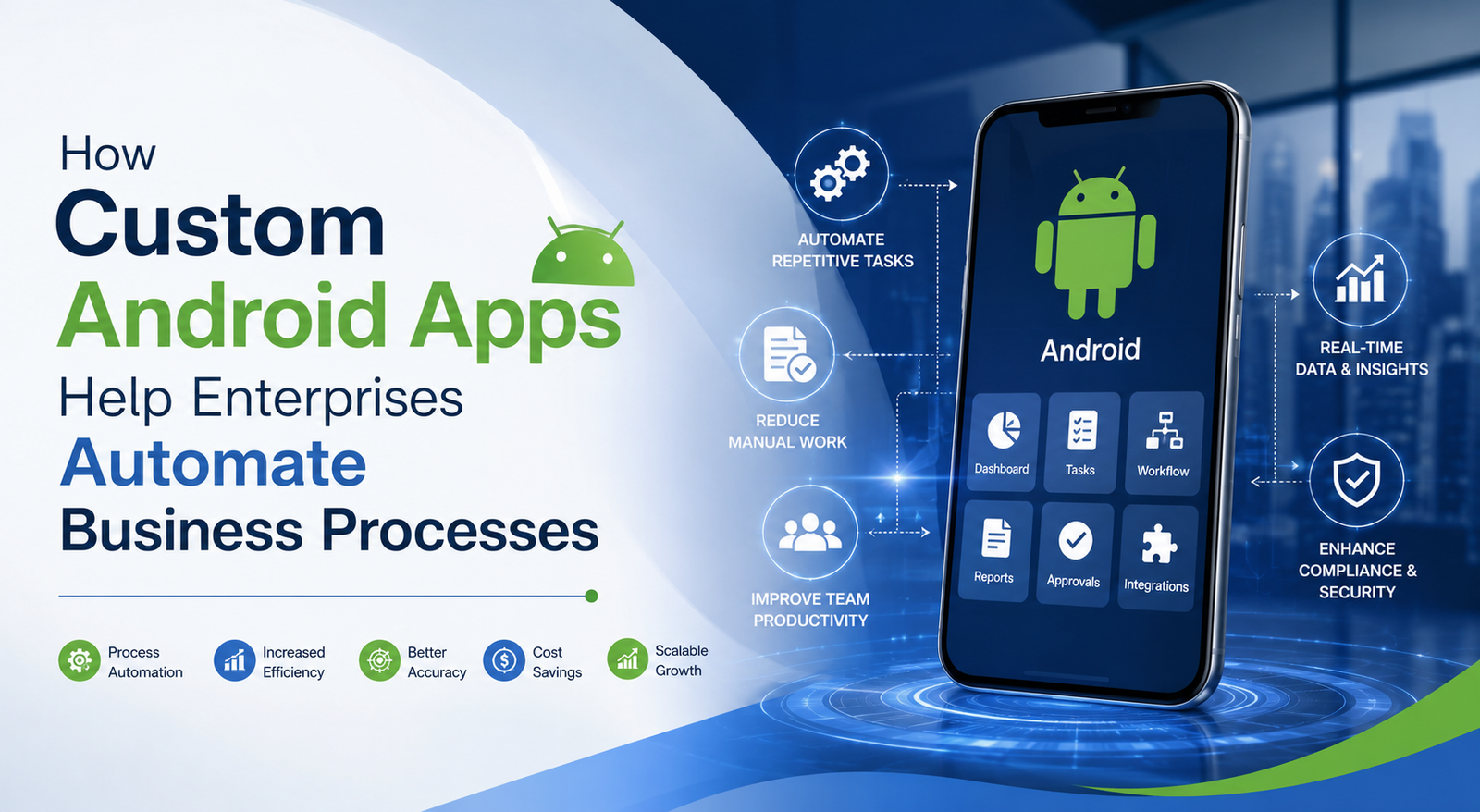
How Custom Android Apps Help Enterprises Automate Business Processes
Modern enterprises handle a wide range of daily activities, from managing employees and customer information to processing orders, tracking field operations, and approving business requests. When these processes rely heavily on spreadsheets, paperwork, emails, or disconnected tools, businesses can face delays and unnecessary manual work.
Custom Android applications offer a practical way to bring many of these processes into a single mobile environment. Designed around specific business requirements, these applications can automate repetitive tasks, connect enterprise systems, provide real-time information, and help employees work more efficiently.
For enterprises looking to modernize their operations, working with an experienced Android App Development Company can help turn complex workflows into streamlined mobile experiences.
What Are Custom Android Apps for Enterprises?
Custom Android apps are mobile applications developed specifically for an organization’s workflows, employees, customers, and operational requirements. Unlike generic business applications, custom solutions can be designed around the exact processes an enterprise needs to manage.
For example, a logistics company may require an Android app for driver tracking, delivery updates, digital proof of delivery, and route management. Similarly, a healthcare organization may need an application for appointment management, patient information, staff communication, and remote monitoring.
This flexibility makes custom Android applications useful for enterprises with unique workflows or complex operational requirements.
Why Enterprises Need Business Process Automation
Business process automation helps organizations reduce repetitive manual work and create more consistent workflows. Instead of requiring employees to complete every step manually, automated systems can perform predefined actions based on specific triggers or conditions.
Automation can help enterprises:
- Reduce repetitive administrative work
- Minimize human errors
- Speed up approvals and task assignments
- Improve communication between teams
- Provide better visibility into operations
- Give employees faster access to business information
Mobile applications make these capabilities accessible wherever employees work, which can be particularly valuable for field teams and distributed workforces.
How Custom Android Apps Automate Business Processes
1. Automating Repetitive Tasks
Many enterprise employees spend significant time performing repetitive activities such as data entry, status updates, report submissions, and task management.
A custom Android app can automate several of these activities. For example, employees can submit information through predefined forms, while the application automatically sends the data to the appropriate system.
Automated notifications can also remind employees about pending tasks, deadlines, or approvals. This reduces the need for constant manual follow-ups.
2. Real-Time Data Collection and Sharing
Traditional processes can create delays when employees collect information on paper and enter it into business systems later.
Custom Android apps allow employees to collect and submit information directly from their mobile devices. Sales representatives, technicians, delivery personnel, and field workers can update records while working.
The information can then be synchronized with centralized enterprise systems, allowing managers and other authorized employees to access updated information more quickly.
3. Automating Approval Workflows
Approval processes often involve multiple people and communication channels. Purchase requests, employee expenses, leave applications, and project documents may require several approval stages.
A custom Android application can create structured approval workflows. Once a request is submitted, the application can automatically notify the relevant manager. After approval or rejection, the next step can be triggered without requiring manual coordination.
This can make business processes more transparent while reducing unnecessary delays.
4. Improving Field Workforce Management
Field employees often need access to business information while working away from the office. Custom Android apps can give them tools for attendance, task management, location tracking, customer information, work orders, and digital reporting.
For example, a field service employee can receive a service request through an Android application, navigate to the customer’s location, update the work status, upload images, and collect a digital signature.
The information can then be shared with the central team in real time, creating a more connected workflow.
5. Integrating Enterprise Systems
Enterprise businesses typically use multiple systems for different functions. CRM platforms may manage customer information, ERP systems may handle financial and operational processes, while HR systems manage employee-related information.
Custom Android applications can connect with these platforms through APIs and other integration methods. This allows employees to access relevant information through one mobile interface rather than switching between multiple systems.
Such integration can be an important part of broader Enterprise App Development Services, particularly when organizations need mobile applications that work alongside existing technology infrastructure.
Key Features of Custom Android Apps for Process Automation
A business-focused Android application can include different features depending on its purpose and industry. Common features include:
- Role-based access: Employees can access functions according to their responsibilities.
- Push notifications: Important updates, reminders, and approvals can be delivered instantly.
- Offline functionality: Employees can continue working in areas with limited connectivity.
- Real-time synchronization: Mobile data can be synchronized with backend systems.
- Dashboards and analytics: Managers can monitor important business metrics.
- Workflow automation: Tasks can move automatically through predefined business processes.
- Document management: Employees can upload, view, and share relevant documents.
- GPS and location services: Useful for logistics, field services, and workforce management.
- Secure authentication: Authentication mechanisms can help protect sensitive enterprise information.
Benefits of Custom Android Apps for Enterprise Automation
Increased Employee Productivity
Employees spend less time on repetitive administrative activities when workflows are automated. A mobile application can provide the right information and tools exactly when they are needed.
Faster Business Operations
Automated notifications, approvals, data synchronization, and task assignments can reduce delays between different stages of a business process.
Reduced Manual Errors
Manual data entry can introduce mistakes, especially when employees have to transfer information between different systems. Structured mobile forms and automated data flows can help reduce these errors.
Better Customer Service
When employees can access customer records, order information, service history, or other relevant data through a mobile application, they can respond to customer needs more efficiently.
Improved Business Visibility
Centralized data and real-time updates can help managers understand what is happening across different teams and locations. This supports faster operational decision-making.
Lower Operational Costs
Automation can reduce the amount of time employees spend on repetitive tasks and paperwork. Over time, this can help organizations use their resources more efficiently.
Industries Using Android Apps for Business Automation
Custom Android applications can support automation across a wide range of industries.
Healthcare: Applications can automate appointments, patient communication, medical workflows, and staff coordination.
Logistics and transportation: Businesses can manage deliveries, fleet operations, driver activities, and real-time tracking.
Retail and eCommerce: Android applications can support inventory management, order processing, customer engagement, and sales operations.
Banking and FinTech: Mobile applications can support account services, transactions, customer verification, and financial workflows.
Manufacturing: Businesses can use mobile applications for production monitoring, inventory tracking, inspections, and workforce management.
Real estate: Property management, customer communication, property inspections, and document workflows can be managed through mobile applications.
Security Considerations for Enterprise Android Apps
Enterprise applications can handle sensitive business, employee, and customer information, making security an important consideration during development.
Businesses should consider secure authentication, data encryption, role-based permissions, secure API communication, and regular security updates. Applications should also be tested for common security vulnerabilities before deployment.
A well-planned security strategy should cover both the Android application and the backend systems with which it communicates.
Custom Android Apps vs. Generic Business Automation Tools
Generic automation platforms can be useful for businesses with simple and standardized workflows. However, enterprises with specialized processes may require greater flexibility.
Custom Android applications can be designed around specific business rules, existing systems, user roles, and operational requirements. They can also evolve as the organization grows.
The right choice depends on factors such as workflow complexity, integration requirements, security needs, budget, scalability, and long-term business goals.
How to Develop a Custom Android App for Business Automation
The development process generally begins by identifying the business processes that need improvement. Teams can then define requirements, user roles, workflows, integrations, and security requirements.
After that, the application can move through UI/UX design, Android development, backend integration, testing, deployment, and maintenance.
Continuous monitoring after launch is also important. Business processes change over time, and enterprise applications may need new features or integrations to support those changes.
How an Android App Development Company Can Help
An experienced Android App Development Company can help enterprises move from manual workflows to connected mobile processes.
A development partner may support requirements analysis, UI/UX design, custom Android development, API integration, security implementation, testing, deployment, and ongoing maintenance.
For larger organizations, the development approach can also include integration with existing CRM, ERP, HR, cloud, analytics, and enterprise management platforms.
The goal is not simply to create another mobile application. Instead, the application should become a useful part of the organization’s broader digital ecosystem.
Future of Enterprise Automation With Android Apps
Enterprise mobile applications are expected to become increasingly intelligent as technologies such as artificial intelligence, AI agents, IoT, predictive analytics, and edge computing continue to develop.
AI-powered Android applications can potentially automate more complex tasks, provide intelligent recommendations, and assist employees with information retrieval and decision-making.
IoT integration can also allow Android applications to receive information from connected devices, while predictive analytics can help businesses identify patterns and potential operational issues.
These developments can make mobile applications an increasingly important component of enterprise digital transformation.
Conclusion
Custom Android applications can help enterprises automate repetitive tasks, connect business systems, improve field operations, streamline approvals, and provide employees with real-time access to information.
When developed around actual business requirements, these applications can go beyond basic mobile functionality and become an important part of an organization’s automation strategy.
With the support of a capable Android App Development Company and well-planned Enterprise App Development Services, businesses can build scalable mobile solutions that support current workflows while remaining flexible enough to adapt to future operational needs.


