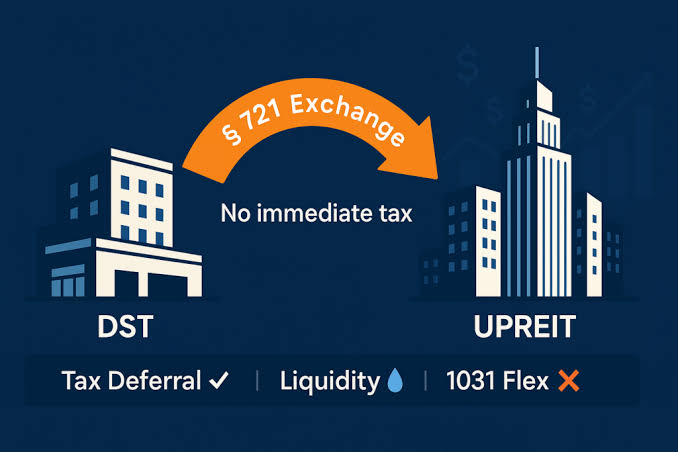
How to Convert a DST 1031 Exchange Into a 721 UpREIT
A 721 UpREIT conversion is not a second 1031 exchange. It is a separate tax-deferred transaction under Internal Revenue Code Section 721, and confusing the two mechanisms is the most common error investors make when a DST sponsor offers this exit. TL;DR: when a Delaware Statutory Trust reaches its disposition event, some sponsors offer investors the choice to contribute their DST interest into the sponsor’s operating partnership in exchange for OP units, deferring tax under Section 721 rather than continuing the like-kind exchange chain under Section 1031. That election ends further 1031 eligibility for that capital and starts a different tax clock. Before electing, check whether the Trust’s offering documents disclosed a 721 UpREIT option at all, since not every DST is structured with one.
This piece walks through the mechanical steps of evaluating and executing a 721 UpREIT conversion out of a DST, what the offering filings actually disclose about the option, and where investors most often misread the tax consequences. It draws on how DST offering documents and sponsor filings are structure, not on any single sponsor’s marketing language. Consult a CPA or real estate attorney before making an election. Nothing here is tax or investment advice.
What You’ll Need
- The DST’s private placement memorandum (PPM) and any supplemental disclosures covering disposition and exit options
- The sponsor’s operating partnership agreement or REIT prospectus, if a 721 option is disclose
- A CPA or tax attorney familiar with Section 721 contributions and partnership basis rules
- Your original 1031 exchange documentation, including the basis carried into the DST
- Access to the sponsor’s track record, including whether it has closed prior 721 UpREIT exits, which is the kind of detail the Top1031 directory structures from SEC filings rather than sponsor decks
Step 1: Confirm the DST’s Offering Documents Disclose a 721 Exit Option
Start with the PPM, not the sponsor’s marketing summary. A 721 UpREIT option has to be disclose as a structural feature of the Trust’s offering, typically describing the sponsor’s affiliated operating partnership and the mechanics of a future OP unit contribution. Some sponsors build this into every offering from a given platform; others never offer it and DST interests are wound down through property sale and cash distribution only.
This distinction matters because it is set at the offering stage, not negotiate at exit. If the PPM is silent on a 721 option, there is no conversion path to evaluate, regardless of what a broker suggests later. Reading why DST offerings are structured with a 721 exit option explains the filing language sponsors use to disclose this feature and what it looks like in an actual PPM versus a summary sheet. A Trust’s SEC filings are the primary source here; sponsor-produce brochures are secondary and should be check against them.
Step 2: Review the Sponsor’s Operating Partnership and Track Record Before the Disposition Notice
A 721 UpREIT conversion moves your capital from a single-asset or small-portfolio DST into the sponsor’s broader operating partnership, which typically holds a much larger and more diversified pool of assets. That is a material change in what you are expose to, and it happens at the sponsor level, not the Trust level.
Before the disposition notice arrives, look at how many prior offerings from that sponsor have closed with a 721 exit rather than a cash sale, and how the sponsor’s operating partnership has performed as a going concern. A Sponsor Grade on Top1031 reflects a sponsor’s track record across its offerings and is not a grade on the specific Trust you hold, so it should never be read as a forecast for how a given 721 conversion will perform. The distinction is explain directly in why Top1031 grades sponsors, not Trusts. Separately, tracking 721 UpREIT exits in the historical Trust record shows how many Trusts in Top1031’s tracked cohort have actually closed this way, since UpREIT exits remain a minority outcome relative to straight property sales.
Step 3: Compare a 721 Contribution Against Continuing Your 1031 Exchange Chain
At disposition, you generally have more than one path: take cash and pay tax, roll proceeds into a new 1031 exchange and a new DST or direct property, or contribute into the sponsor’s operating partnership under Section 721. Only the second path preserves the like-kind exchange chain under Section 1031. The 721 route defers tax through a different mechanism entirely, and once you hold OP units, you are no longer holding real property directly for 1031 purposes.
DST hold vs. 721 UpREIT conversion and DST vs. 721 UpREIT liquidity and tax deferral both lay out this fork in plain terms. The choice is not about which is safer, since that depends on facts specific to your basis, holding intent, and estate plans. It is about which deferral mechanism you want to be under going forward.
Step 4: Model the Tax Deferral Mechanics of the OP Unit Contribution
A Section 721 contribution defers gain recognition at the time of the exchange, similar in effect to a 1031 exchange, but the rules governing what happens next are partnership tax rules, not like-kind exchange rules. Your basis in the DST interest carries over into your basis in the OP units. Gain is not recognize until you dispose of the OP units, commonly when the sponsor converts them to REIT shares in a later transaction, which is typically a taxable event unless structured otherwise.
This is where investors most often assume the deferral is permanent and indefinite in the same way a properly executed 1031 exchange can be. It is not automatically so. Get the specific mechanics of the sponsor’s OP unit redemption terms from the operating partnership agreement, not from a summary conversation, and have a tax preparer model what a future REIT share conversion would trigger given your basis.
Step 5: Evaluate What You Give Up in Estate Planning Flexibility
One reason some investors decline a 721 conversion is the step-up in basis available to heirs. A 1031 exchange preserves the ability to defer gain until death, at which point heirs typically receive a step-up basis and the defer gain is never recognize. Once you convert into OP units, that calculus can change depending on how the sponsor’s partnership and any subsequent REIT structure treat basis at transfer.
DST 1031 exchanges for estate planning and step-up in basis covers this in more detail and is worth reading before, not after, an election. This is squarely a conversation for an estate planning attorney, not a sponsor representative.
Step 6: Get the Election Document With Your CPA and Attorney Before the Deadline in the Disposition Notice
Sponsors typically set a window for investors to elect cash, a 1031 rollover, or a 721 contribution once a disposition is announce. That window is set by the sponsor’s timeline, not the 45-day identification period from your original exchange, which has already close by this stage. Missing the sponsor’s election window forecloses the option by default, usually defaulting you into cash distribution and a taxable event.
Have your CPA and attorney review the operating partnership agreement’s contribution terms before you sign anything. This is also the point to revisit exiting a DST before the sponsor’s target hold period if the disposition is happening earlier than the sponsor’s original target hold, since early exits carry their own set of disclosure questions.
Step 7: Execute the Election and Confirm the Contribution Is Document as a Section 721 Transaction
Once you elect the 721 path, confirm the closing documents reflect a partnership contribution under Section 721, not a sale. The distinction affects how the transaction is report to the IRS and what basis carries forward. Your tax preparer will need the closing statement, the operating partnership agreement, and your original basis records from the 1031 exchange that placed you into the DST.
Common Mistakes
Assuming the 721 conversion keeps your 1031 exchange chain alive. It does not. Section 721 and Section 1031 are different deferral mechanisms, and moving into OP units means you are no longer holding replacement real property directly.
Treating a Sponsor Grade as a prediction that the 721 exit will go smoothly. A Sponsor Grade reflects Top1031’s evidence-based read of a sponsor’s tracked record.
Not checking whether the specific DST’s PPM ever disclosed a 721 option. Some sponsors offer it on some Trusts and not others, even within the same platform.
Overlooking that OP unit-to-REIT-share conversion is typically a later taxable event. The 721 contribution defers tax at the point of exchange; it does not eliminate the eventual tax question.
Skipping the estate planning conversation. Basis and step-up treatment can differ materially once capital moves from a DST interest into OP units.
Tools and Resources
- The Top1031 directory for checking a sponsor’s currently active offerings and whether prior Trusts from that sponsor closed via a 721 exit, cash sale, or continued hold
- SEC EDGAR (sec.gov) for the underlying PPM and Form D filings that disclose a 721 option in the sponsor’s own regulatory language
- IRS.gov guidance on Section 1031 and Section 721 for the statutory text governing each deferral mechanism
- A CPA or tax attorney with partnership tax experience, since the OP unit basis and later conversion rules are partnership tax questions, not like-kind exchange questions
FAQ
Is a 721 UpREIT exchange the same as a 1031 exchange?
No. A 1031 exchange defers gain by exchanging real property for like-kind real property. A 721 UpREIT contribution defers gain by exchanging a DST interest for units in an operating partnership under a different section of the tax code. They are sequential options at a DST’s disposition, not the same mechanism.
Can I do another 1031 exchange after I convert my DST interest into OP units?
Once you hold OP units, you generally hold a partnership interest rather than real property, which is not eligible for a further 1031 exchange. Confirm this with a tax professional based on the specific structure of the operating partnership.
Does every DST sponsor offer a 721 exit option?
No. It depends on how the specific Trust’s offering was structure and whether the sponsor operates an affiliate operating partnership. Check the PPM rather than assuming the option exists.
How do I check a sponsor’s history with 721 UpREIT exits before my DST reaches disposition?
Review the sponsor’s tracked record for prior Trusts on that platform, including how many closed through 721 conversions versus straight property sales, rather than relying on the current offering’s marketing materials alone.
Is the gain deferred through a 721 contribution taxed later?
Typically yes, most commonly when the OP units are later convert to REIT shares, which is generally a taxable event. The precise treatment depends on the specific operating partnership agreement and your basis.
Where This Leaves You in 2026
A 721 UpREIT conversion is a real option in some DST offerings, disclosed at the PPM stage rather than negotiated at exit, and it moves your capital under a different section of the tax code than the 1031 exchange that placed you in the DST. Checking whether a specific Trust’s filings disclose the option, and how the sponsor’s operating partnership has perform across prior 721 exits, is verification work best done with the underlying SEC filings rather than sponsor summaries. The Top1031 directory structures those filings by sponsor and by Trust for exactly that kind of comparison heading into a 2026 disposition decision. What to verify before electing: the PPM’s 721 disclosure language, the operating partnership agreement’s redemption terms, and your CPA’s read on what basis carries forward.