
Zinn Hub vs PeoplePerHour: Which UK Freelance Marketplace Is Better for Freelancers?
PeoplePerHour is the established UK freelance marketplace. Zinn Hub is the newer UK marketplace built around lower fees, multilingual hiring and several ways to sell.
Both are British companies. They are also built around noticeably different models.
PeoplePerHour has been operating since 2007 and has the advantage of an established UK buyer base. Zinn Hub, operated by Zinn Digital Ltd, was incorporated in England and Wales in April 2025.
So this is not simply a question of which marketplace is bigger.
It is a question of which model suits the freelancer or buyer in front of you.
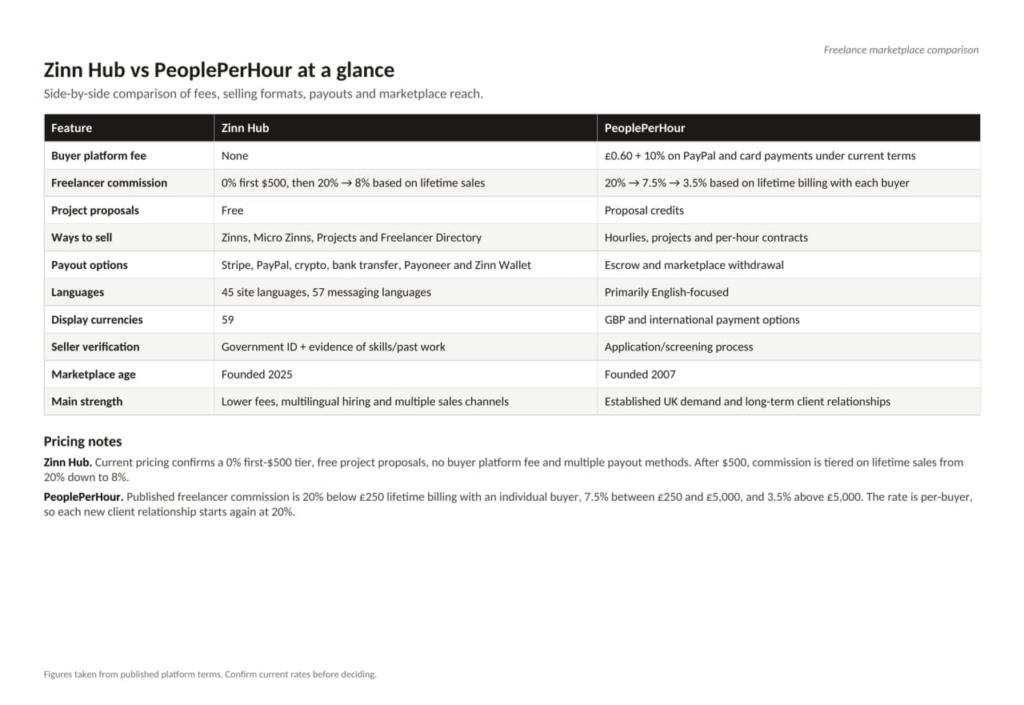
Zinn Hub’s current pricing confirms its 0% first-$500 tier, free project proposals, no buyer platform fee and multiple payout methods.
PeoplePerHour’s published freelancer commission is 20% below £250 lifetime billing with an individual buyer, 7.5% between £250 and £5,000 and 3.5% above £5,000.
Choose Zinn Hub if the first $500 matters
This is one of the biggest differences between the two platforms.
On PeoplePerHour, the commission calculation is per buyer.
A freelancer starts at 20% with each new buyer. Once that particular buyer has generated more than £250 in lifetime billing, the rate falls to 7.5%. After £5,000 with that same buyer, it falls to 3.5%.
That structure rewards long-term relationships.
But it can be expensive for freelancers whose business consists of lots of smaller, one-off jobs.
Imagine a freelancer wins ten £150 projects from ten different buyers.
Each relationship starts in the 20% bracket.
Zinn Hub takes a different approach.
The first $500 in sales across the platform is commission-free, regardless of which buyers generated those sales. After that, the standard commission is based on lifetime sales on Zinn Hub, rather than resetting with every new client.
The current Zinn Hub structure is:
● $0–$500: 0%
● $501–$2,500: 20%
” $2,501–$10,000: 15%
● $10,001–$15,000: 13%
” $15,001–$20,000: 10%
● $20,001+: 8%
There are also Pro and Agency memberships with flat 8% and 7% rates respectively.
That makes Zinn Hub particularly interesting for freelancers building a new stream of work from multiple buyers.
Buyers get a very different checkout
The difference is not only on the freelancer side.
Zinn Hub says buyers pay no platform fee. Its pricing promise is straightforward: the price displayed for the service is the platform price, before any applicable payment-processing considerations.
PeoplePerHour’s current terms state that buyers using PayPal or credit/debit cards pay a service fee of £0.60 plus 10%.
That creates a meaningful difference.
A freelancer might advertise a £100 service on PeoplePerHour, but the buyer’s final payment can be higher because of the buyer fee.
On Zinn Hub, there is no separate Zinn Hub platform fee added to the buyer’s purchase. For freelancers, that can make the advertised price more competitive.
For buyers, it makes comparing the advertised price with the actual platform price much simpler.
Proposals are another clear difference
Zinn Hub includes project proposals as part of its marketplace.
The current Free tier includes 25 project proposals per month, with higher allowances on paid plans. There are no bidding credits to purchase.
PeoplePerHour uses proposal credits.
That does not necessarily make one system universally better. It simply creates a different incentive.
Zinn Hub makes submitting proposals part of the free marketplace experience.
PeoplePerHour gives freelancers a recurring proposal allocation and allows additional credits to be purchased.
For freelancers who regularly apply for lots of projects, that difference can become significant.
Zinn Hub gives freelancers more than one route to work
This is another area where the platforms differ.
A Zinn Hub freelancer can:
Sell Zinns — fixed-price packaged services.
Sell Micro Zinns — small services priced at $5, $10, $15 or $20.
Respond to Projects — submit free proposals for custom work.
Use the Freelancer Directory — allow buyers to discover and hire them directly. All of these can operate from the same Zinner account.
PeoplePerHour also has several hiring models.
Its Hourlies provide fixed-price packaged services, while Projects and per-hour contracts cover more customised work.
PeoplePerHour therefore remains useful for freelancers who want a mixture of packaged offers and traditional project relationships.
The difference is that Zinn Hub has deliberately combined its fixed-price marketplace, project bidding and freelancer directory into one model.
Language is where Zinn Hub takes a very different approach
This may be the most significant product difference.
Zinn Hub currently operates across 45 site languages, while buyers can communicate with freelancers in 57 messaging languages. Prices are displayed in 59 currencies, although transactions themselves are charged in USD.
Listings, messages and other marketplace content can be translated, and Zinn Hub supports live language translation during calls.
That creates a different kind of international marketplace.
A freelancer does not necessarily need perfect English to sell to an English-speaking buyer.
Likewise, a UK business can work with a freelancer whose first language is Spanish, Polish, Portuguese, French or another supported language.
PeoplePerHour is itself available internationally and UK freelancers can certainly work with overseas clients.
But multilingual communication is not the central product proposition in the same way it is on Zinn Hub.
For freelancers looking to expand beyond English-speaking clients, that distinction matters.
Verification is another point of difference
Zinn Hub requires sellers to provide government-issued photo ID and evidence of their skills and previous work before they can list services or respond to Projects.
That creates a more controlled seller catalogue.
For buyers, verification can provide another layer of information when deciding who to hire.
For freelancers, it also means the marketplace is not simply an open shelf where anyone can immediately publish a service without going through verification.
The trade-off is that a verification requirement can contribute to a smaller catalogue, particularly while a newer marketplace is still growing.
Payouts are built differently
Zinn Hub gives sellers the option of connecting their own Stripe or PayPal account, allowing buyers to pay them directly at checkout.
Alternatively, sellers can use platform-protected payments and receive payouts through options including PayPal, cryptocurrency, bank transfer and Payoneer.
That gives Zinners a choice between direct payment and platform-protected transactions.
PeoplePerHour uses its own marketplace payment and escrow system, with withdrawals handled through the platform.
For freelancers who care about getting money into their own payment account as quickly as possible, Zinn Hub’s direct Stripe and PayPal option is a significant distinction.
Where PeoplePerHour still has the advantage
A fair comparison has to acknowledge what PeoplePerHour brings to the table. It has been operating since 2007.
That means years of accumulated reviews, buyer relationships, search visibility and marketplace history.
For a freelancer who already has several long-standing PeoplePerHour clients, moving everything to another marketplace may make little commercial sense.
The 3.5% commission tier can also become attractive when a freelancer has generated more than £5,000 in lifetime billing with the same buyer.
For example, an established freelancer with a long-term agency client generating £10,000 or £20,000 a year could benefit significantly from PeoplePerHour’s lowest per-client commission tier.
PeoplePerHour also has native hourly contracts, making it particularly useful for ongoing time-based work.
Where Zinn Hub has the stronger proposition
Zinn Hub’s strengths are particularly obvious when the freelancer is dealing with new buyers and international digital work.
Consider a freelancer who:
● Has lots of one-off buyers
● Sells fixed-price digital services
” Wants to test a new marketplace
● Wants the first $500 commission-free
● Does not want buyers paying a marketplace surcharge
” Wants free project proposals
● Works with clients across different languages
● Wants direct Stripe or PayPal payments
” Wants to sell both packaged services and custom projects
That is precisely the type of freelancer Zinn Hub’s model is designed around.
A simple example
Consider a freelancer selling a roughly $100 equivalent service to a new buyer. PeoplePerHour
The freelancer begins in the 20% commission tier for that buyer, subject to the platform’s published fee rules. The buyer may also face the current £0.60 + 10% fee when paying by PayPal or card.
Zinn Hub
If the freelancer is still within their first $500 in Zinn Hub sales, the marketplace commission is 0%.
The buyer does not pay a Zinn Hub platform fee.
That gives Zinn Hub a particularly strong proposition for someone building a new client base.
But what happens after the first $500?
This is where the comparison becomes more nuanced.
Zinn Hub’s 0% introductory rate eventually gives way to its standard tiered commission structure.
PeoplePerHour, meanwhile, becomes increasingly attractive when a freelancer develops a substantial relationship with the same buyer.
A freelancer who reaches £5,000 lifetime billing with one PeoplePerHour buyer moves into the 3.5% tier for that buyer.
So the two platforms reward different behaviours.
PeoplePerHour rewards repeat business with the same client.
Zinn Hub rewards overall growth on the platform.
That is an important distinction when you compare PeoplePerHour V Zinn Hub.
When each marketplace fits
Situation Platform to
consider
New marketplace, multiple one-off buyers Zinn Hub
First $500 in marketplace sales Zinn Hub
Buyer wants no Zinn Hub platform fee Zinn Hub
International multilingual hiring Zinn Hub
Fixed-price digital services Zinn Hub
Free project proposals Zinn Hub
Direct Stripe or PayPal payments Zinn Hub
Established UK buyer relationships PeoplePerHour
Long-term relationship with one client PeoplePerHour
£5,000+ lifetime billing with the same buyer PeoplePerHour
Hourly contracts and ongoing time-based work PeoplePerHour
Need an established UK marketplace PeoplePerHour
The honest limitations
Zinn Hub is the newer marketplace.
PeoplePerHour has had nearly two decades to build its buyer base, reviews and search presence.
That matters.
A freelancer cannot manufacture years of marketplace history overnight.
Zinn Hub therefore has to continue expanding its catalogue, attracting buyers and building transaction history across more categories.
But being newer also gives Zinn Hub room to build around problems that have become increasingly important in modern freelance work.
Lower platform fees.
Transparent buyer pricing.
Multilingual communication.
Seller verification.
Multiple ways to generate work.
Direct payment options.
And international hiring without making English the requirement for every conversation.
Zinn Hub vs PeoplePerHour: which one should you use?
For a freelancer with a large existing PeoplePerHour client base, there is a strong reason to keep using PeoplePerHour.
For someone building a new freelance income stream, selling packaged digital services, targeting international buyers or working with lots of different clients, Zinn Hub presents a very different proposition.
And there is no requirement to choose only one.
A freelancer can maintain a PeoplePerHour profile while building a Zinn Hub storefront. That may actually be the most useful way to approach the comparison. Use PeoplePerHour where its established buyer relationships already generate work.
Use Zinn Hub where its lower-fee model, multilingual infrastructure and multiple sales channels give you an additional opportunity.
The bottom line
PeoplePerHour is the established UK marketplace. Zinn Hub is the newer UK challenger built around a different model.
PeoplePerHour’s biggest asset is its accumulated marketplace demand.
Zinn Hub’s biggest advantages are its 0% first-$500 commission, no buyer platform fee, free project proposals, multilingual infrastructure, verified sellers and direct Stripe/PayPal payment options.
If you already have a valuable long-term PeoplePerHour client base, there is little reason to abandon it. But you can import all your services & reviews to Zinn Hub with a click of a button, via “import my services”
But if you are looking for a new marketplace where the first $500 is commission-free, buyers are not charged a separate platform fee and international language barriers are deliberately built out of the buying process, Zinn Hub makes a compelling case for being the newer alternative worth trying.